Finance
Debt, Equity and Everything Between: A Field Guide to Business Finance for Nigerian and African SMEs
The main types of business finance, the development banks and SME lenders that serve Nigerian and African businesses, and how to spot loan scams.
Photograph: Unsplash. Unsplash Licence. Source
By Sir John Edumoh, CEO of Astudity Limited
> Last verified: November 2026. Every institution and product in this guide was checked on its official website in November 2026. Rates, limits and windows change. Confirm current terms directly with the lender before you apply.
Ask ten Nigerian business owners what holds them back, and most will say the same word: capital. Ask them what kind of capital they need, and the answers become vague. Yet the type of money you take matters as much as the amount. The wrong finance at the wrong time can sink a sound business. The right one can carry an average business a long way.
This guide explains the main types of business finance in plain terms, maps the development finance institutions (DFIs) and SME lenders that serve Nigerian and African businesses, and shows how to approach them. It ends with a section on loan scams, which are now as common as genuine offers.
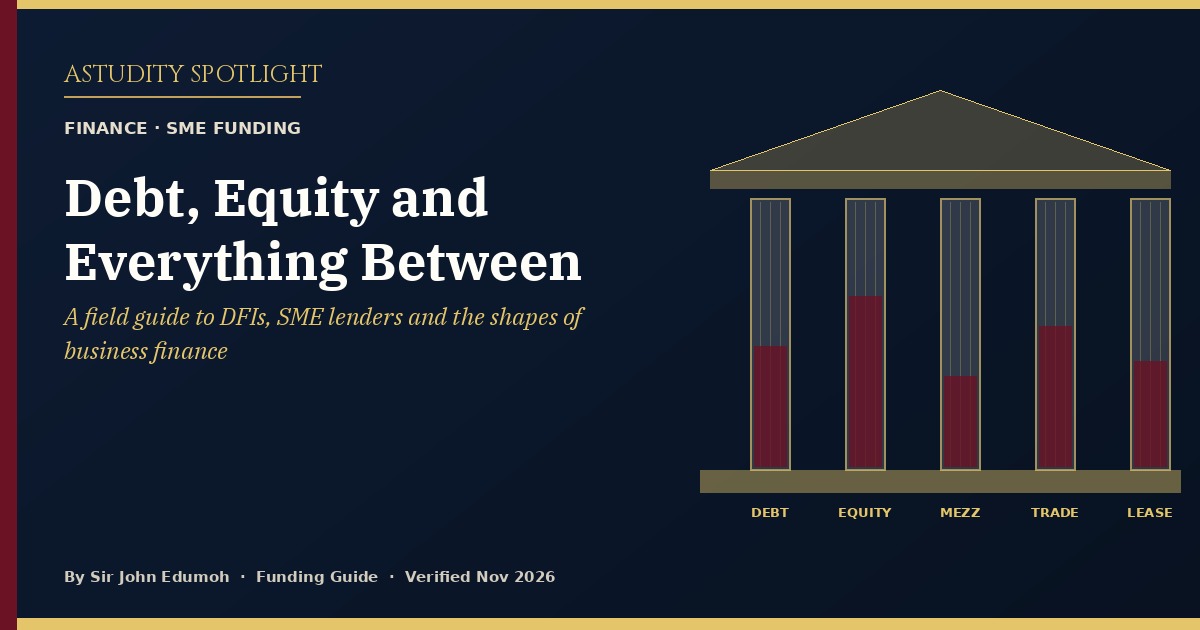
Part one: the five shapes of business finance
### 1. Debt (loans)
You borrow a fixed sum and repay it with interest over an agreed period, whether the business does well or not. You keep full ownership. Term loans fund long-life assets such as machines and buildings. Working-capital loans fund stock, raw materials and day-to-day operations, and are usually shorter.
Good for: businesses with predictable cash flow and a clear use of funds. Watch: collateral and guarantor requirements, the true annual cost (a monthly rate of 3.99% is far more than 3.99% a year), and whether repayments match your sales cycle. A moratorium (a grace period before principal repayments start) is valuable for projects that take time to produce income.
### 2. Equity
An investor buys a share of your company. There is no repayment schedule, but you give up part of your ownership and future profits, and usually some control through board seats or investor rights.
Good for: fast-growing businesses whose returns will come later, and where a loan would strangle cash flow. Watch: dilution, valuation, and the rights you sign away. Our companion article on angel investors explains these terms in detail.
### 3. Mezzanine finance
A hybrid between debt and equity. It is usually a loan that ranks behind senior bank debt and carries a higher return, often with the right to convert into equity or a share of profits. DFIs such as FMO list mezzanine structures among their instruments.
Good for: established, profitable businesses that need growth capital beyond what banks will lend, without selling a large equity stake. Watch: complex terms and a higher cost than ordinary loans.
### 4. Invoice and trade finance
Invoice finance advances cash against invoices your customers have not yet paid. Trade finance covers import and export transactions through letters of credit, guarantees and pre-shipment finance. The lender's comfort comes from the transaction and the quality of your buyer, not only from your balance sheet.
Good for: suppliers to large companies or government, and importers and exporters with confirmed orders. Watch: fees per transaction, and the risk that a buyer pays late or disputes the invoice.
### 5. Leasing and asset finance
The lender buys an asset (a vehicle, generator, tractor or production line) and you pay to use it, with an option to own it at the end. The asset itself is the main security.
Good for: businesses that need equipment but lack land or property to offer as collateral. Watch: total cost over the lease term, insurance, and maintenance obligations.
### A sixth option: revenue-based financing (RBF)
With RBF, a financier advances capital and you repay through a fixed percentage of monthly revenue until an agreed total is reached. Repayments rise in good months and fall in slow ones, and you give up no shares. It suits businesses with steady, recorded revenue but no appetite for dilution.
Part two: who provides it
### Nigerian public development finance
Bank of Industry (BOI). Nigeria's development bank for industry and enterprise. Applications are made through the official MyBOI portal (onlineportal.boi.ng), which supports CAC-registered businesses in submitting applications and tracking status. A flagship product is GLOW (Guaranteed Loans for Women), a ₦10 billion fund for women-owned businesses: up to ₦10 million for micro enterprises and up to ₦50 million for SMEs, at 7% per annum all-inclusive, with tenors up to five years including a six-month moratorium on principal. GLOW funds asset and raw-material finance in value-adding sectors and excludes trading and primary agriculture. Security ranges from one external guarantor for loans below ₦5 million to a bank guarantee or legal mortgage for ₦10–50 million.
Development Bank of Nigeria (DBN). DBN does not lend directly to businesses. It provides wholesale funding and partial credit guarantees to Participating Financial Institutions (PFIs): commercial banks, microfinance banks and other licensed lenders. DBN's website reports 84 PFIs and ₦1.4 trillion disbursed as of December 2025. According to DBN, start-ups and existing MSMEs in productive enterprises are eligible, with tenors of up to 10 years and moratoriums of up to 18 months. To access it, go to your bank and ask specifically for a DBN-funded loan; the bank appraises you and applies to DBN.
Lagos State Employment Trust Fund (LSETF). For businesses operating in, and owners resident in, Lagos State. Its MSME Loan Programme is priced at 9% per annum: micro-enterprise loans of ₦50,000–₦500,000 (12 months), start-up loans of ₦50,000–₦250,000, and SME loans of ₦500,000–₦5 million (24–36 months). Applicants contribute equity of 5% of the loan, and need a LASRRA ID, LIRS tax ID, BVN and bank statements. Status: the application portal (apply.lsetf.ng) shows "closed" as of November 2026. Prepare your documents now and watch the official portal.
### Continental and international DFIs
A key fact most SMEs do not know: the big DFIs rarely lend directly to small businesses. They lend to, guarantee or invest in local banks and funds, which then serve SMEs. Your route to their money is usually a local bank.
African Development Bank (AfDB) and AFAWA. The AfDB's Affirmative Finance Action for Women in Africa works through more than 200 partner financial institutions. It uses lines of credit, trade finance and equity investments, earmarking 30% for women's SMEs, and an AFAWA guarantee that covers up to 75% of losses on women's loan portfolios. Ask your bank if it holds an AFAWA facility.
International Finance Corporation (IFC, World Bank Group). IFC states clearly that it "does not lend directly to micro, small, and medium enterprises or individual entrepreneurs." Larger private projects in member developing countries can approach IFC directly with an investment proposal; there is no standard application form.
FMO (Dutch entrepreneurial development bank). Through the MASSIF fund it manages for the Dutch government, FMO finances local financial intermediaries that serve micro, small and medium enterprises, with a focus on the unbanked, agriculture and rural livelihoods, and women and youth entrepreneurs.
Proparco (AFD Group, France). In February 2026, Proparco signed a ₦9 billion (€5 million) ARIZ portfolio guarantee with Wema Bank, covering 50% of final loss risk, so that Wema can build an ₦18 billion MSME loan portfolio over two years in agriculture, healthcare, education, pharmaceuticals, green finance and working capital.
British International Investment (BII, UK). BII invests largely through funds and financial institutions. One current example: an $8 million commitment, made in August 2025, to Ventures Platform Pan-African Fund II, which invests in early-stage African technology businesses.
Mastercard Foundation Africa Growth Fund. A fund-of-funds that backs African-led investment vehicles, which in turn invest equity in SMEs that create work for young people and women.
### Fintech and specialist SME lenders
Carbon Business. CBN-licensed. Business loans from ₦100,000 to ₦9.5 million, no collateral, from 3.99% per month (rate set by credit assessment), tenors up to 6 months for new customers and 12 months for returning ones.
Moniepoint MFB. A CBN-licensed microfinance bank serving millions of businesses, offering business loans alongside accounts and payments.
Unconventional Capital (RBF). Provides €20,000–€100,000 in revenue-based financing to registered limited companies in Kenya, Rwanda, Uganda and Nigeria with at least two years of operations and at least €80,000 in revenue over the last 12 months, in sectors including food and agriculture, trade and logistics, financial services and climate.
Fintech credit is fast and convenient, but it is usually more expensive per year than DFI-backed loans. Use it for short, self-liquidating needs, such as stock you will sell within weeks, not for long-term assets.
Reference table
| Institution / product | Who it is for | Amount / terms | How to access | Official link |
|---|---|---|---|---|
| BOI (MyBOI portal) | CAC-registered MSMEs | Product-specific | Apply online | onlineportal.boi.ng |
| BOI GLOW | Women-owned businesses | Up to ₦50m; 7% p.a.; up to 5 yrs | MyBOI / BOI offices | glow.boi.ng |
| Development Bank of Nigeria | MSMEs via 84 PFIs | Up to 10-yr tenor; market rates | Through your bank (PFI) | devbankng.com |
| LSETF MSME Loans | Lagos-resident businesses | ₦50k – ₦5m; 9% p.a. | Portal closed Nov 2026 | lsetf.ng |
| AfDB AFAWA | Women-led SMEs | Credit lines; up to 75% guarantee | Through partner banks | afawa.afdb.org |
| IFC | Larger private projects; SMEs via banks | Project-specific | Investment proposal / local banks | ifc.org |
| FMO MASSIF | MSMEs via local lenders | Debt, mezzanine, equity | Through intermediaries | fmo.nl |
| Proparco – Wema guarantee | Nigerian MSMEs | ₦18bn portfolio | Through Wema Bank | proparco.fr |
| British International Investment | SMEs/tech via funds | Fund-specific | Through BII-backed funds | bii.co.uk |
| Mastercard Fdn Africa Growth Fund | Job-creating SMEs | Equity via fund managers | Through portfolio funds | africagrowthfund.org |
| Carbon Business | Nigerian businesses | ₦100k – ₦9.5m; from 3.99%/month | Online | getcarbon.co |
| Moniepoint MFB | Small businesses | Product-specific | App / online | moniepoint.com/ng |
| Unconventional Capital | Registered firms, €80k+ revenue | €20k – €100k RBF | Online | unconventional.capital |
How to approach a lender
1. Know your number and your purpose. "I need ₦12 million to buy a second oven that raises output by 40%" beats "I need funding." 2. Match the money to the need. Long assets need long loans or leases. Stock needs short working capital. Uncertain, fast growth may need equity. 3. Build the file before you need it. CAC documents, tax clearance, 12 months of bank statements, management accounts, a cash-flow projection covering the loan period, and pro-forma invoices for what you will buy. BOI's GLOW checklist is a good model even if you never apply to BOI. 4. Bank with intention. Because DBN, AFAWA, Proparco and IFC money flows through banks, your relationship with your bank is your doorway to DFI funds. Keep your business income going through one business account. 5. Read the whole offer. Annual cost, fees, insurance, guarantor obligations, penalties and what happens if you repay early.
Loan and investor scams: how to protect yourself
Loan fraud now borrows the names of real institutions. BOI's official fraud page is a model of what to watch for:
- Upfront "processing", "registration", "insurance" or "approval" fees paid before disbursement, especially into a personal account. BOI says payments must only go into designated BOI corporate accounts confirmed through an official BOI office.
- Unsolicited offers by WhatsApp, SMS, phone or social media for a loan or grant you never applied for. BOI says its genuine offers "are never unsolicited."
- Guaranteed approval for a fee or a share of the loan. No BOI employee can guarantee approval in exchange for money, gifts or a share of the facility.
- Requests for your BVN, NIN, OTP, PIN or banking password.
- Lookalike domains and personal email addresses. BOI lists fakes such as boi-ng.com, myboiportal.net, b0i.ng, boi-loans.org and bo1.ng. Genuine BOI email ends in @boi.ng, and its only application portal is onlineportal.boi.ng.
- Fake "DFI agents". IFC, FMO, Proparco and BII do not run individual SME loan schemes through agents on social media. If someone claims to sell you "IFC funding", walk away.
To verify: type the institution's web address yourself; call the number published on its website (BOI's contact centre is 0700-CALL-BOI, ); confirm that any approval letter has a reference number you can check with a branch; and for fintech lenders, confirm they are licensed by the Central Bank of Nigeria. If you have already paid, contact your bank at once and report to the institution being impersonated and to the Nigeria Police Force or the EFCC.
In property and in publishing, I have learned that capital is a tool, and every tool has a right and a wrong use. A cheap DFI-backed loan used to buy stock that sits in a warehouse is still a bad loan. An expensive short-term facility that turns over three times in a quarter can be good business.
My advice to every SME owner is to stop asking "Where can I get money?" and start asking "What shape of money fits this need, and can my cash flow carry it?" Get your records in order, build a real relationship with a bank that carries DBN or DFI lines, and treat any stranger who wants a fee before funding as what they are: a thief with good stationery.
This article is for education and is not financial or legal advice. Details were last verified in November 2026; confirm all terms with the institution before applying.