Legal Metrology
Legal Metrology in Nigeria: The Law, the Institutions and the Buyer at the Counter
How Nigeria's Weights and Measures Act works, the roles of the Weights and Measures Department, SON and the FCCPC, fuel-pump and scale verification, how to complain, and what recent enforcement has shown.
Photograph: Unsplash. Unsplash Licence. Source
Nigeria does not lack a legal metrology law. It has a statute, a specialised department of government, a national metrology institute, and a clear rule that trade must be conducted in metric units. The live question is whether that machinery is strong enough to protect the buyer at a filling station, a supermarket shelf or an open market stall, and whether businesses know what the law requires of them. This article sets out the main features of that system. I have used the statute and named official or reputable sources only. Where the public record is incomplete or inconsistent, I say so.
The Weights and Measures Act
The principal statute is the Weights and Measures Act, Cap W3, Laws of the Federation of Nigeria 2004. It is an older law, with important amendments, including the 1978 provisions on the exclusive use of metric units. The Director of the Weights and Measures Department, Dr Salim Mohammed, has described the existing law as dating back to independence and as prescribing penalties that no longer deter dishonest practice. That judgement does not cancel the Act's present force.
The Act's first purpose is uniformity of measurement. Section 1 makes the metre the unit of length and the kilogramme the unit of mass by reference to which measurements in Nigeria are to be made. Section 52 is unambiguous: as from 1 January 1979 it has been unlawful, for trade or any other commercial transaction, to possess, use or import weights, measures, instruments or goods in imperial units or in any units other than exclusive metric units.
Section 6 forbids the use for trade of any unit of length, area, volume, capacity, mass or weight that is not in the First Schedule, and of any measure that is not in the Third Schedule. In October 2026, Dr Mohammed reminded traders that only metric units are lawful, and that local measures such as the mudu, derica and kongo are not legal units except where the department has approved the mode of production.
The heart of the enforcement system is the control of instruments. Under section 7, no person may use, or possess for use, prescribed weighing or measuring equipment for trade unless an inspector has passed it as fit for such use and, except where the Act provides otherwise, it bears an undefaced stamp. The inspector must test the equipment with working standards, issue a certificate of verification if it falls within the prescribed limits of error, stamp it, and keep a record of the test. An instrument that is removed and re-installed must be retested before it may lawfully be used again. Under section 14, a certificate of verification remains in force for twelve months, unless, in limited cases, its operation is extended for not more than one further period not exceeding twelve months.
Prepackaged goods are dealt with in section 28. A person may not sell, or have in his possession for sale, any pre-packed article unless the wrapper, container or a securely attached label bears a true statement of the minimum net weight or measure of the contents, marked conspicuously in plain block characters. Goods listed in the Eighth Schedule must also be made up in the standard quantities specified there. The Director warned manufacturers and retailers in November 2026 that packing outside those specified quantities, without a valid waiver, is a serious offence, and that such products are liable to be confiscated.
Inspectors have substantial powers under section 16. Subject to production of credentials, they may inspect and test trade equipment, inspect relevant goods, enter premises other than a private dwelling-house, and seize articles liable to forfeiture. They may also seal premises where they reasonably believe an offence has been, is being or is likely to be committed, subject to a report, a right of appeal, and a limit of 28 days without a court order.
The penalties, however, show their age. Unless otherwise prescribed, an individual convicted of an offence under the Act is liable to a fine of ₦500 or imprisonment for one year, or both, and a body corporate to a fine of ₦5,000. Those sums were fixed in a different economy. It is no surprise that the department is reviewing the regulations with a view to higher fines.
One further statutory limit is often overlooked. Section 50 provides that, without the approval of the Minister, the Act does not apply to instruments used for dealings with land, for the measurement or consumption of electricity, gas or water, or for the hire of a taxi. Utility metering therefore sits in a special position, which I discuss more fully in the companion article on business and investment.
The Weights and Measures Department
Legal metrology policy and enforcement sit with the Weights and Measures Department of the Federal Ministry of Industry, Trade and Investment. The Standards Organisation of Nigeria, the country's National Metrology Institute, states the division of labour plainly: SON is responsible for scientific and industrial metrology, while the department formulates and implements legal metrology policy. Traceability is intended to be derived from the national standards in SON's custody.
The department's mandate, as its Director restated in November 2026, is national. Weights and measures is on the Exclusive Legislative List of the Constitution, and the Act vests in the department the duty to verify every weighing and measuring instrument used for trade. The Director was explicit that this covers oil and gas as well as the non-oil economy, and that, in his view, no sector-specific law has taken that duty away. Sector regulators, he said, regulate the industry; the department guarantees the measurement.
The department maintains offices across the states and the Federal Capital Territory, with zonal offices and a headquarters in Abuja. In a November 2026 interview with the News Agency of Nigeria, Dr Mohammed identified inadequate funding, insufficient personnel and limited operational vehicles as major constraints, noting that about 70 per cent of the department's work is in the field. He said operations were about 65 per cent automated, with a plan to reach 90 to 100 per cent, including a mobile app for complaints. Completing digitalisation and securing agency status are 2027 priorities.
SON, the BIPM and the FCCPC
A legal metrology system is only as good as the standards behind the inspector's working weights. SON is the custodian of Nigeria's national primary measurement standards and has been designated as the National Metrology Institute. It offers calibration in mass, length, temperature and pressure, and is responsible for guaranteeing the traceability of those national standards to SI units.
That international link has been strengthened this year. On 4 June 2026, Nigeria became an Associate State of the BIPM, allowing it to be represented, without voting rights, at the General Conference on Weights and Measures, to join the CIPM Mutual Recognition Arrangement, and to use BIPM capacity-building activities. On 13 October 2026, the Director General of SON signed the CIPM MRA. As a signatory, the institute can participate in international comparisons and publish Calibration and Measurement Capabilities in the CIPM MRA database. Nigeria participates through SON, a member of AFRIMETS, the intra-African regional metrology organisation recognised by the CIPM. That step does not, by itself, make a market scale more accurate. It does mean Nigeria has formally joined the system through which measurement results are compared and recognised internationally.
The Federal Competition and Consumer Protection Commission is the other close partner. In October 2026 the Director said the department's nationwide market-surveillance drive, themed "Full Measure, Fair Trade," would be conducted with the FCCPC and SON's National Metrology Institute. Planned operations included announced verification, unannounced spot-checks, mystery-shopper purchases and joint enforcement, with results to be published and repeat offenders named, covering petroleum, open markets, supermarkets, pharmaceuticals, aviation, agriculture and export terminals.
Fuel pumps, scales and the consumer's complaint
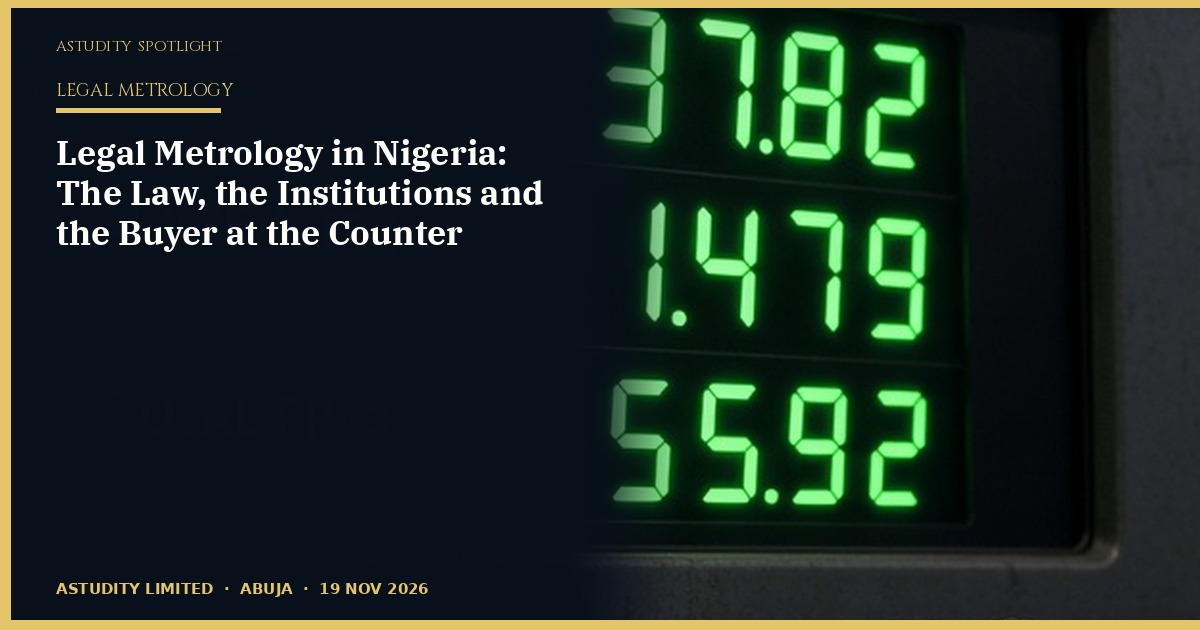
For most Nigerians, legal metrology is encountered at a pump or a scale. The department inspects instruments used in petroleum retail outlets, water-supply services and ordinary commercial transactions. Equipment that passes receives a twelve-month certificate, which does not bar a later inspection. Equipment outside acceptable tolerance is prohibited from use, and non-compliant prepackaged goods are to be taken off the shelves. First-time offenders are typically given warnings and notices of rejection, with a period to recalibrate; repeated violations may be prosecuted. The department has said it has prosecuted offenders in Taraba, Jigawa, Oyo, Sokoto and Katsina States.
Consumers are advised to check for verification stickers, especially on petroleum dispensing pumps, before buying. In Lagos, the department has told the public it can receive complaints at its offices in Ijora and Ikeja, covering filling stations, gas companies, supermarkets, open markets, butcher shops and manufacturers. The Lagos zonal coordinator has suggested a practical test: if a pack labelled 10 kilogrammes appears light, a buyer can check it on a scale at home and then report the discrepancy.
What recent enforcement has shown
The most detailed official account of 2025 activity came in a 13 November 2026 interview with NAN. Dr Mohammed said 546,136 weighing and measuring equipment items had been verified across oil and non-oil sectors. He said 92 per cent were found compliant and certified for trade, and 8 per cent were found non-compliant and issued notices of rejection, with a period to rectify deficiencies through recalibration. NAN's headline put the failure rate at about 10 per cent. The detailed counts printed in the same interview do not arithmetically match those percentages, so I rely here on the director's rounded official description: the great majority of instruments passed, and a material minority did not. Follow-up inspections are supposed to confirm that corrections have been made before a fresh certificate is issued.
In mid-November 2026 the department carried the message into Lagos shops and lubricant depots. At a supermarket inspection, officials said the scales met the required standards, though at least one prepackaged product had a weight discrepancy. At a TotalEnergies facility in Kirikiri, Apapa, lubricant packs examined were said to conform to their declared quantities, with further visits planned at other depots, including Ardova, Conoil and NNPC.
The picture that emerges is not of a lifeless law. Inspectors are in the field, certificates are being issued, and some cases are going to court. It is also not a finished system. The penalties are tiny, the inspectorate is thinly stretched, and too many buyers still cannot tell whether the pump or pack in front of them has been recently and honestly verified. Strengthening that system is one of the more direct ways the state can protect household income and honest trade at the same time.