Investor Relations
When a Rating Agency Grades the Boardroom: Lessons From S&P's Nvidia Warning
S&P has put NVIDIA's AA rating on CreditWatch Negative over board oversight and succession after the CEO's removal and reinstatement. It is a lesson for every board, including Nigeria's.
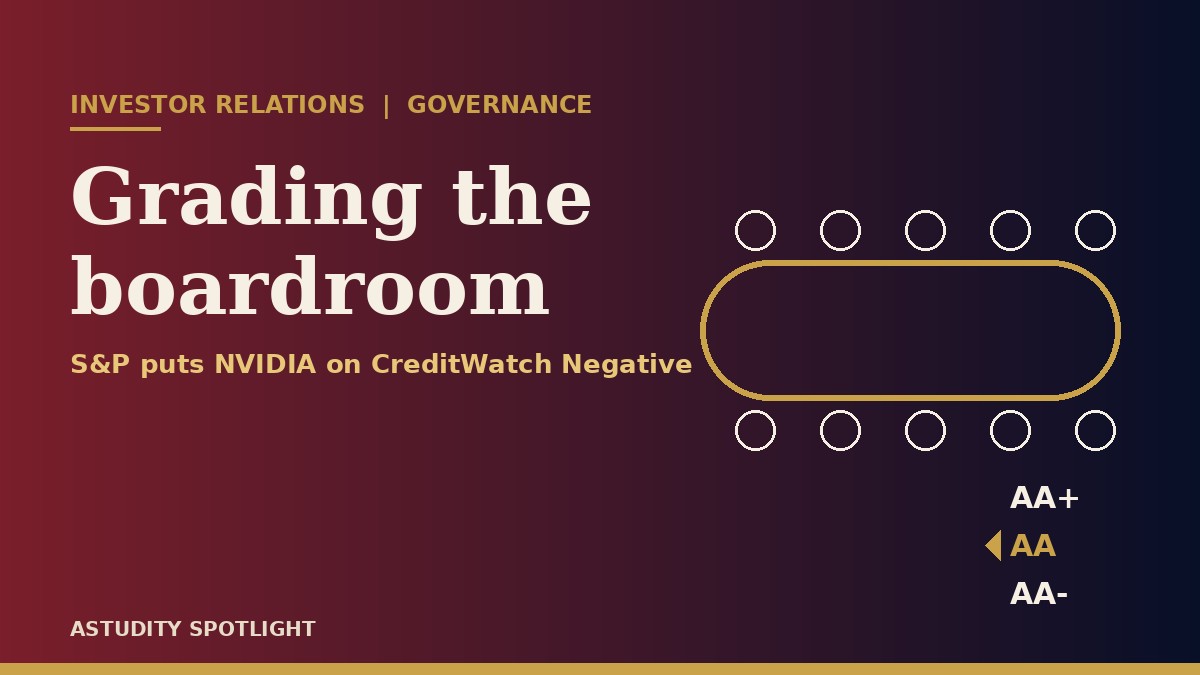
Cover graphic by Astudity Spotlight. Logos belong to their owners.
- On Monday, 23 November 2026, NVIDIA's board voted unanimously to reinstate co-founder Jensen Huang as President, CEO and a director, effective immediately. The board said it was satisfied with his candour and ability to lead, and that it had received input from senior levels of the US government indicating that his return poses no national security risk, according to NVIDIA's press release and its Form 8-K.
- The same release said an investigation by a committee of independent directors, with independent counsel, will proceed to conclusion; that a new National Security and Export Control Committee of independent directors has been formed; and that the company is searching for a Chief Compliance Officer reporting to the Nominating and Corporate Governance Committee, according to NVIDIA.
- On Wednesday, 25 November, S&P Global Ratings placed NVIDIA's 'AA' ratings on CreditWatch Negative, saying the CEO's departure and reinstatement did not sufficiently answer its questions about board oversight of executive conduct, according to Reuters via Investing.com and S&P Global Ratings.
- S&P said a downgrade, if it comes, would likely be one notch to AA- within 90 days. It cited the long tenure of certain directors as a possible threat to their independence, weak executive oversight, a lack of succession planning, "key man" risk, and questions about internal controls and geopolitical risk management. It said it was unaware of any remedial action by the board and intends to meet the board and management, according to CNBC.
- Moody's changed its outlook on NVIDIA to stable from positive on 18 November, citing governance concerns. NVIDIA shares rose as much as 36% during Monday's session after the reinstatement but were down about 12.5% from Monday's close by the time of CNBC's report. NVIDIA has about $32.5 billion of bonds in the US high-grade corporate bond index, according to Bloomberg, as reported by CNBC.
A Credit Warning That Has Nothing to Do With Cash
What makes this episode remarkable is what S&P did not say. It did not question NVIDIA's revenue, its margins or its ability to repay debt. One of the most profitable companies in the world has been put on watch for a downgrade because of how its board is built and how it supervises its chief executive. Governance has moved from the footnotes to the credit rating.
Long Tenure, Weak Oversight and the Key-Man Problem
In arbitration and in criminology, we learn the same lesson: oversight fails quietly, long before it fails publicly. Directors who have sat beside a founder for decades may be honourable and highly capable, yet independence is not only about character; it is about distance. When a board removes a chief executive and then restores him within days, investors are entitled to ask what changed, who decided, and on what evidence. The new committees and the compliance officer search are sensible steps. S&P is effectively saying that steps announced are not yet steps proven.
The key-man point matters too. A company worth this much should never depend on one person so heavily that his absence moves the share price by double digits in a day. Succession planning is not disloyalty to a founder. It is a duty to every shareholder and bondholder.
Why Nigerian Boards Should Pay Attention
This is not only an American story. Nigerian companies, banks and the large new listings now coming to the NGX are often built around strong founders and long-serving directors. Lenders, rating agencies and foreign investors apply the same tests everywhere: genuine board independence, documented oversight of the CEO, a credible succession plan, and prompt disclosure when something goes wrong. A weak board raises the cost of capital, whatever the profits say.
The Takeaway for Investors
Read governance as you read a balance sheet. Ask how long directors have served, who truly oversees the chief executive, and whether a named succession plan exists. For NVIDIA bondholders, the next 90 days and the outcome of the independent investigation are the things to watch. For every board, the lesson is simple: build your checks before you need them.
This is opinion and not investment advice.