Astudity Insights · No. 01 · Finance
How Money Moves in Nigeria
The Central Bank, the banks and the markets, explained
A plain guide to the institutions that set the price of money in Nigeria, the figures that matter as at November 2026, and how to read them for yourself.
Every naira you earn, save, borrow or invest passes through a system most people never see. A central bank sets the price of short-term money. Commercial banks take deposits and lend them on. Markets price government debt, company shares and foreign currency every working day. Regulators decide who may take part and on what terms. When any one of these parts moves, it shows up in your rent, your salary, your loan repayments and the price of fuel.
This guide explains how the parts fit together, using the most recent official figures we could verify, and shows you how to read the signals for yourself.
At a glance: Nigeria’s money dials, as at November 2026
- Monetary Policy Rate (MPR): 23%, set on 22 September 2026, down from 26.5%
- Headline inflation: 14.06% year on year in October 2026; food inflation 19.13%; core inflation 10.78%
- Official exchange rate (NFEM close): ₦1,394/$ on 20 November 2026
- Gross external reserves: $54.65 billion on 19 November 2026
- One-year Treasury bill stop rate: 15.89% at the 11 November 2026 auction
- Real GDP growth: 4.43% year on year in Q2 2026
- NGX All-Share Index: 247,660.74 at the close on 20 November 2026
1. The Central Bank of Nigeria: setting the price of money
The Central Bank of Nigeria (CBN) has a short list of jobs with very long consequences: keep prices stable, issue the currency, manage the external reserves, supervise banks and keep the payment system working. Its main tool for price stability is the Monetary Policy Rate, decided by the Monetary Policy Committee (MPC).
The MPR is a signal. It anchors the rates at which the CBN lends to banks overnight and takes their surplus cash. In September 2026 the MPC “reset” the MPR to 23% and recalibrated the corridor around it to +50/−300 basis points. In plain terms, banks can borrow from the CBN’s standing lending facility at about 23.5% and place spare cash at the standing deposit facility at about 20%. The Committee was clear that this was an operational realignment, meant to bring the MPR back into line with rates actually traded in the market, and not a change in its tight policy stance.
That distinction is worth learning. A falling policy rate does not always mean “cheap money is coming”. Sometimes, as here, it means the central bank is repairing the plumbing so that its signal is taken seriously again.
The next MPC meeting is scheduled for 23–24 November 2026. Whatever it decides, the communiqué is published on the CBN website and is the primary source; read it before you read the commentary.
2. Inflation: the number behind every other number
Inflation is the rate at which the general price level rises. The National Bureau of Statistics (NBS) publishes the Consumer Price Index each month. In October 2026 headline inflation was 14.06%, down from 14.63% in September and 18.97% in October 2025.
Three details in that release show why one headline figure is never enough:
- Food inflation was 19.13%, well above the headline rate. Households that spend most of their income on food feel a higher inflation rate than the average.
- Core inflation, which strips out farm produce and energy, was 10.78%. It is a better guide to underlying pressure.
- Month-on-month inflation rose to 0.43% from 0.06%. The annual rate is falling, but prices are still rising each month.
The chart below shows how far the picture has moved. In 2024 inflation ran well above the policy rate; since early 2025 it has been below it, and the gap has widened, which is why the MPC felt able to reset the MPR in September 2026 without loosening its stance.
The policy rate and inflation, January 2024 to November 2026
Monetary Policy Rate (end of month) and headline inflation, year on year
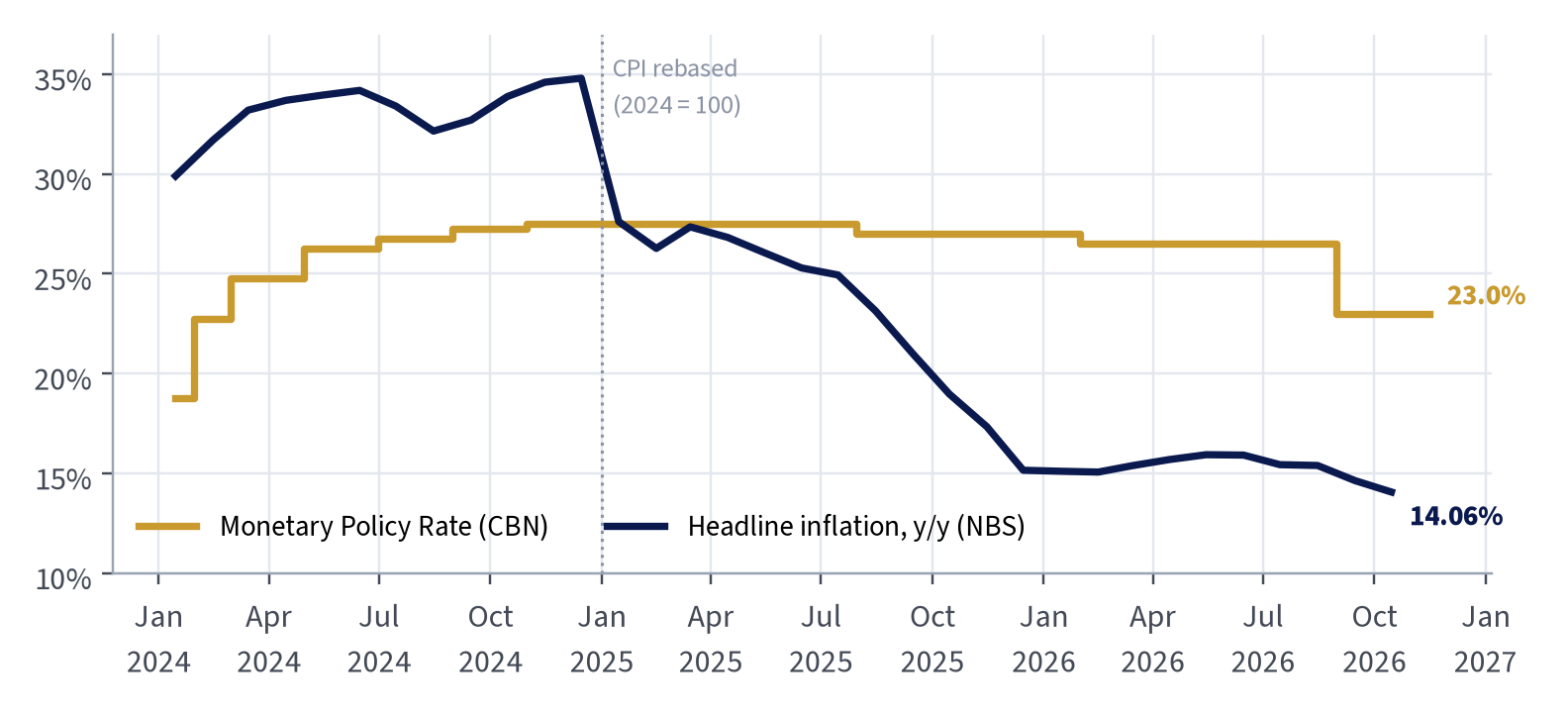
Why it matters for finance: an interest rate only means something once you compare it with inflation. A deposit paying 10% when prices rise 14% is quietly losing value. Economists call the difference the real interest rate, and it is the single most useful idea in this whole guide.
3. Banks: where deposits become loans
Commercial banks take in deposits, keep part of them as reserves and lend the rest. Their profit comes mainly from the gap between what they pay depositors and what they charge borrowers, plus fees.
Two rules shape how safe that system is.
Capital. Capital is the owners’ money that absorbs losses before depositors are hurt. In March 2024 the CBN gave banks until 31 March 2026 to raise their minimum capital to ₦500 billion for banks with international licences, ₦200 billion for national banks and ₦50 billion for regional banks. When the window closed, the CBN said 33 banks had met the new requirements, raising ₦4.65 trillion in fresh capital, about 72.55% from local investors and 27.45% from abroad; a small number remained subject to regulatory and legal processes.
Reserves and deposit insurance. The MPC kept the cash reserve requirement for deposit money banks at 45% in September 2026. That is cash banks must leave with the CBN rather than lend out, which is one reason loans stay expensive. Separately, the Nigeria Deposit Insurance Corporation (NDIC) insures deposits in deposit money banks up to ₦5 million per depositor per bank.
What this means for you
If you keep large balances, spreading them across more than one licensed bank keeps more of your money inside the ₦5 million NDIC cover. Check that an institution is licensed on the CBN website before you deposit anything.
4. The capital market: where long-term money is raised
Banks are good at short-term lending. Long-term money, the kind that builds factories, roads and homes, is usually raised in the capital market: the market for shares (equities) and bonds.
In Nigeria, the Securities and Exchange Commission (SEC) is the regulator. The Investments and Securities Act 2025 (ISA 2025), which replaced the 2007 Act, names the SEC the “apex regulatory authority for the Nigerian capital market” and gives it the objectives of protecting investors, keeping markets fair, efficient and transparent, reducing systemic risk and supporting capital formation. The Act also brings virtual and digital assets within the definition of securities and expressly prohibits Ponzi and pyramid schemes.
Nigerian Exchange (NGX) is where most listed shares trade. On 20 November 2026 the NGX All-Share Index closed at 247,660.74 and equity market capitalisation was ₦160.80 trillion. The index is a summary of the prices of listed shares; it tells you the direction of the market, not whether any single company is a good business.
The Debt Management Office (DMO) manages the Federal Government’s borrowing. It sells FGN bonds, FGN Savings Bonds and, through the CBN, Treasury bills. At the 11 November 2026 auction the stop rates were 15.40% (91-day), 15.79% (182-day) and 15.89% (364-day), with investors bidding about ₦1.08 trillion for the one-year bill alone.
5. The foreign exchange market: the naira’s price
The naira’s exchange rate is the price of a dollar in naira. The CBN publishes a daily rate from the Nigerian Foreign Exchange Market (NFEM). On 20 November 2026 the naira closed at ₦1,394/$, having weakened for five sessions in a row from ₦1,360/$ on 16 November, even as the CBN sold dollars to meet demand.
The naira against the US dollar
CBN official US$ rate, month-end, November 2023 to 20 November 2026 (₦ per US$)
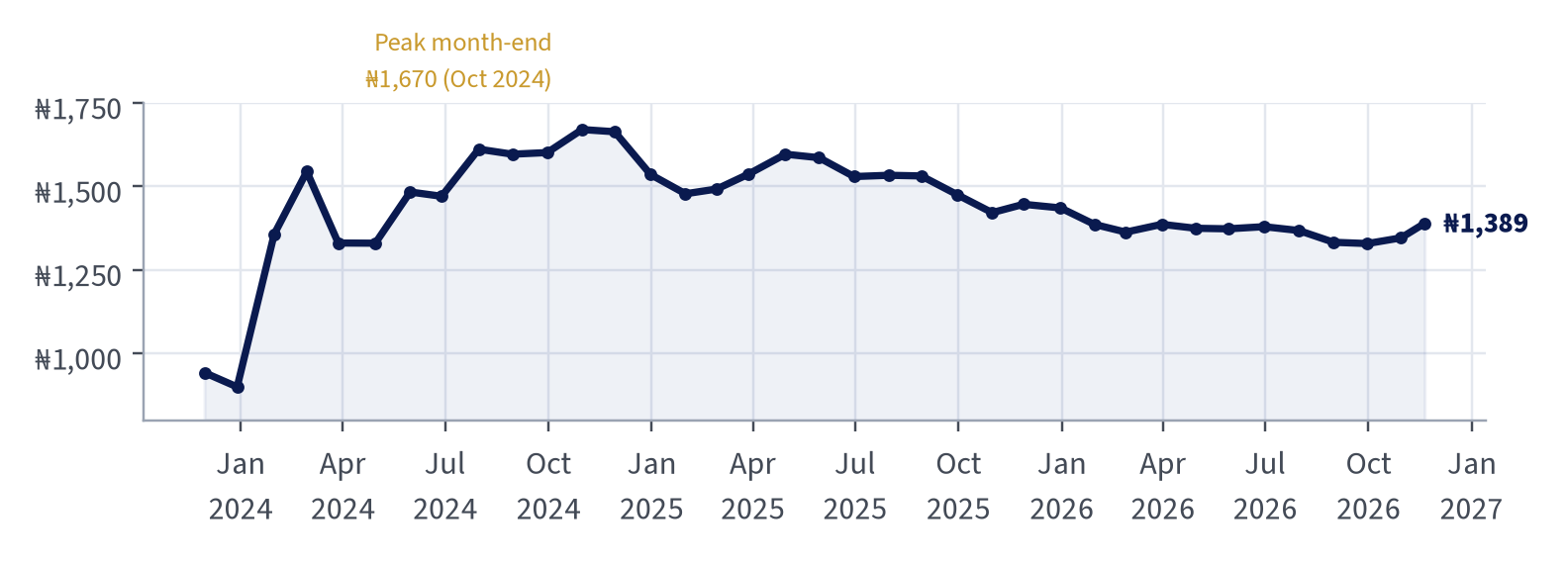
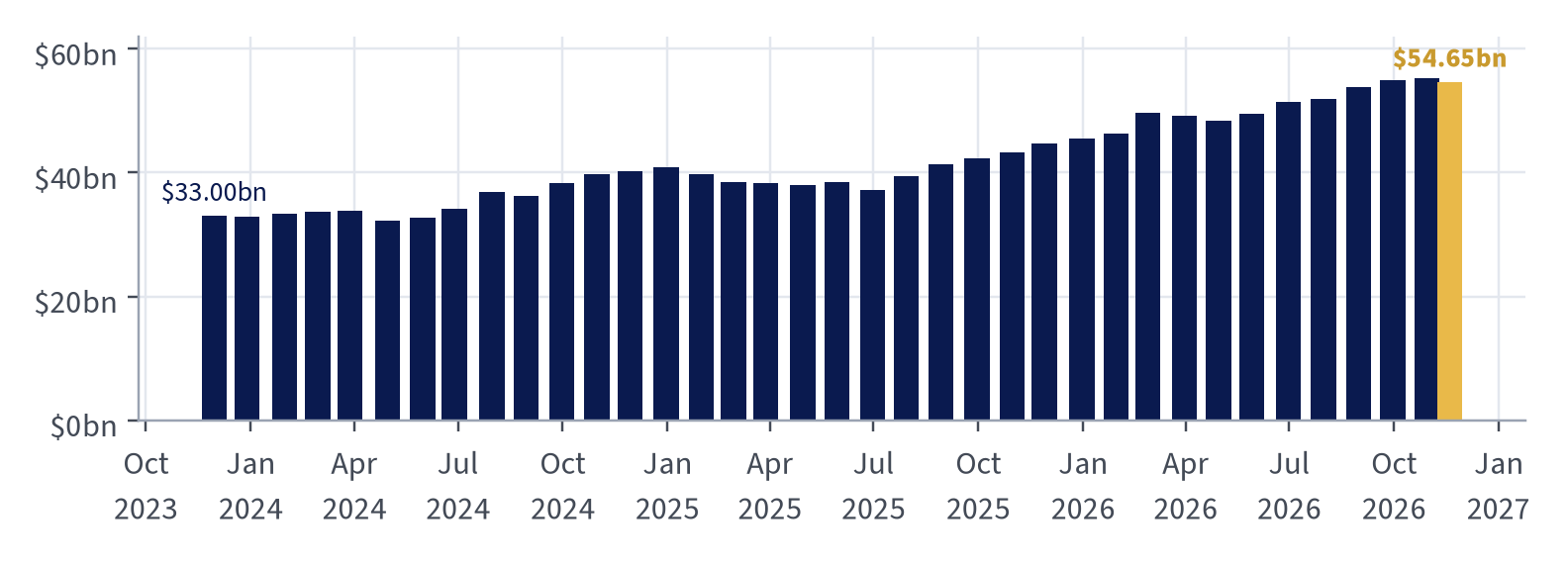
The exchange rate feeds directly into inflation, because Nigeria imports much of its fuel, machinery, medicines and many foods. Reserves matter because they are the CBN’s buffer for smoothing sharp moves; gross reserves stood at $54.65 billion on 19 November 2026. CBN data show that is up from $32.91 billion at the end of December 2023.
Nigeria's gross external reserves
Month-end, November 2023 to 19 November 2026 (US$ billion)
6. Growth: the size of the cake
Gross domestic product (GDP) measures what the economy produces. The NBS reported real GDP growth of 4.43% year on year in Q2 2026, up from 3.89% in Q1. Growth matters for finance because it drives company earnings, tax revenue and the demand for credit.
7. How the parts connect: one worked chain
A worked chain of cause and effect
- The naira weakens against the dollar.
- Imported goods and fuel cost more in naira, so inflation pressure rises.
- The CBN must decide whether to hold or tighten policy to protect price stability.
- Treasury bill and bond yields adjust, which changes what banks pay on deposits and charge on loans.
- Companies face higher or lower financing costs, and share prices adjust to the change in expected profits.
- Households feel it in prices, borrowing costs and the return on their savings.
Read the chain in reverse, too: steady inflation and stable reserves give the CBN room to ease, which can lower borrowing costs over time.
8. Reading the signals yourself
You do not need a terminal to follow the system. Five primary sources cover most of what matters:
- CBN: MPC communiqués, exchange rates and reserves data.
- NBS: monthly CPI and quarterly GDP reports.
- DMO: auction results and FGN Savings Bond offers.
- SEC Nigeria: the ISA 2025, circulars, and lists of registered operators.
- NGX: daily market reports and company filings.
Read the primary release first, then the analysis. When a headline gives a figure without a date, find the date. Most financial confusion comes from comparing numbers from different months.
Key takeaways
- The MPR is the CBN’s main signal; at 23% it remains a tight setting, with a corridor of +50/−300 basis points.
- Compare every interest rate with inflation. The real rate is what matters.
- Bank safety rests on capital, reserves and deposit insurance (₦5 million per depositor per bank at deposit money banks).
- The SEC is the apex capital-market regulator under the ISA 2025; check registration before you invest.
- The exchange rate, inflation and interest rates move together. Learn the chain, and the news makes more sense.
Self-check
- What is the difference between the MPR and the rate your bank charges you?
- If your deposit earns 12% and inflation is 14.06%, is your money growing in real terms?
- Which body regulates the Nigerian capital market, and under which Act?
- Name two ways a weaker naira can push up inflation.
- Where would you find the official Treasury bill auction results?
Answers: 1. The MPR is the CBN’s policy signal; bank lending rates add risk, cost and margin. 2. No; the real return is negative. 3. The SEC, under the ISA 2025. 4. Dearer imports and dearer fuel. 5. The CBN and DMO websites.
Glossary
Basis point: one-hundredth of a percentage point (0.01%).
Cash reserve requirement: the share of deposits a bank must keep with the central bank.
Core inflation: inflation excluding volatile farm produce and energy prices.
MPC: the CBN’s Monetary Policy Committee, which sets the MPR.
NFEM: the Nigerian Foreign Exchange Market, the official FX market.
Real interest rate: the nominal rate minus inflation, roughly.
Stop rate: the highest rate the DMO accepts at a Treasury bill auction.
Where Astudity comes in
Astudity Limited publishes Astudity Spotlight, a business news portal from Abuja that covers banks, markets, the CBN and company results in plain English. This guide is the foundation for that coverage: if you understand the chain above, every MPC decision and results season becomes easier to read.
This publication is educational and is not personalised financial advice. Figures are dated and may have changed since publication. Consider your own circumstances and speak to a licensed adviser before making financial decisions.
More from Astudity Insights
No. 02 · Money
Making Every Naira Count
Personal finance when prices keep rising
How to budget, save, protect and grow household money in Nigeria, with naira examples, today's official rates and the rules that protect you.
No. 03 · Investment
Risk, Return and the Real Rate
An investor's primer for Nigeria
What investing really means, how to compare Treasury bills, bonds, shares and funds on equal terms, and how to protect yourself while you build long-term wealth.
No. 04 · Business Education
Running the Numbers
Business fundamentals for Nigerian founders and SME owners
The financial statements, cash habits, compliance duties and funding choices that separate businesses that last from businesses that merely survive.
No. 05 · Investor Relations
Earning the Market's Trust
Investor relations for growing companies, from first investor to the Exchange
What investor relations is, how the work changes as a company grows, the Nigerian rules that already apply, and a practical playbook for boards and founders.