Astudity Insights · No. 03 · Investment
Risk, Return and the Real Rate
An investor's primer for Nigeria
What investing really means, how to compare Treasury bills, bonds, shares and funds on equal terms, and how to protect yourself while you build long-term wealth.
Saving is putting money aside. Investing is putting money to work: buying an asset you expect to produce income or rise in value over time, in return for accepting some risk. Every investment decision is a trade between three things: return (what you hope to earn), risk (what could go wrong, and how badly) and liquidity (how quickly you can turn it back into cash).
This primer explains those trade-offs in a Nigerian setting, using rates that were current in November 2026, and ends with a checklist you can use before you commit a single naira.
Investment benchmarks, as at November 2026
- Inflation: 14.06% year on year (October 2026)
- Treasury bills (11 Nov 2026 stop rates): 15.40% (91-day), 15.79% (182-day), 15.89% (364-day)
- FGN Savings Bonds (Nov 2026): 13.25% (2-year), 14.25% (3-year)
- NGX All-Share Index: 247,660.74; market capitalisation ₦160.80 trillion (20 Nov 2026)
- Naira (NFEM close): ₦1,394/$ on 20 Nov 2026, from ₦1,360/$ on 16 Nov
- Pension assets: ₦31.80 trillion at end-August 2026
1. The real rate: the one number to calculate first
A return quoted in naira is a nominal return. What you care about is the real return: how much more you can buy at the end than at the start. A quick, accurate way to work it out is:
Real return = (1 + nominal return) ÷ (1 + inflation) − 1
Worked example: two government instruments
364-day Treasury bill at a 15.89% stop rate. Treasury bills are sold at a discount. At that rate a ₦100 bill costs about ₦84.15, so the return on the money actually paid is about 18.9% before fees. Against October’s 14.06% inflation, the real return is (1.189 ÷ 1.1406) − 1 ≈ 4.2%.
Three-year FGN Savings Bond at 14.25%. Real return against the same inflation figure: (1.1425 ÷ 1.1406) − 1 ≈ 0.2%. You are roughly keeping pace with prices, not getting ahead.
Caution: these compare a forward-looking return with last month’s inflation. If inflation keeps falling, the real return improves; if it rises again, it shrinks. Fees, and 7.5% VAT on those fees, also reduce what reaches you.
History shows why this matters. Through 2024 and most of 2025, the one-year Treasury bill stop rate sat below inflation, by more than ten percentage points for much of 2024, so bill holders lost purchasing power. Since December 2025 it has been above inflation every month, though at times only narrowly.
Treasury bill rates against inflation
364-day bill stop rate (last auction each month) and headline inflation, January 2024 to November 2026
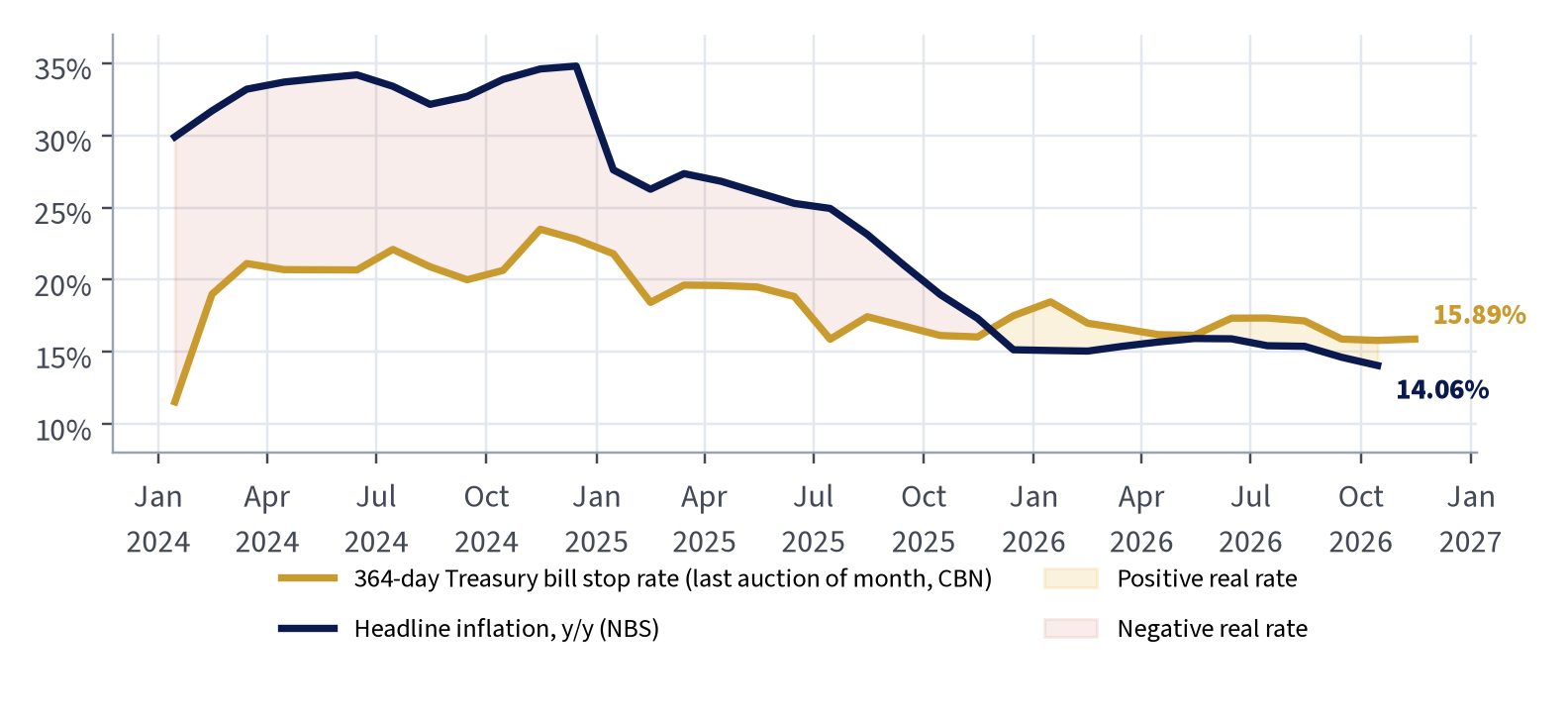
The lesson is not that one product is “good” and another “bad”. It is that headline rates cannot be compared until you put them on the same footing: same time period, after costs, after inflation.
2. The main asset classes, in plain terms
Cash and deposits. Safe up to the NDIC limit and instantly available, but often a negative real return when inflation is high.
Treasury bills (91, 182, 364 days). Short-term Federal Government debt. Very low default risk in naira, but your money is generally tied up until maturity unless you sell in the secondary market at whatever price is available.
FGN bonds and FGN Savings Bonds. Longer-term government debt paying fixed interest. Savings Bonds are designed for retail investors: from ₦5,000, interest paid quarterly, listed on NGX. Their price can fall if market interest rates rise, which matters only if you sell before maturity.
Corporate bonds and commercial paper. Debt issued by companies. They usually pay more than government debt because there is more risk that the company cannot pay.
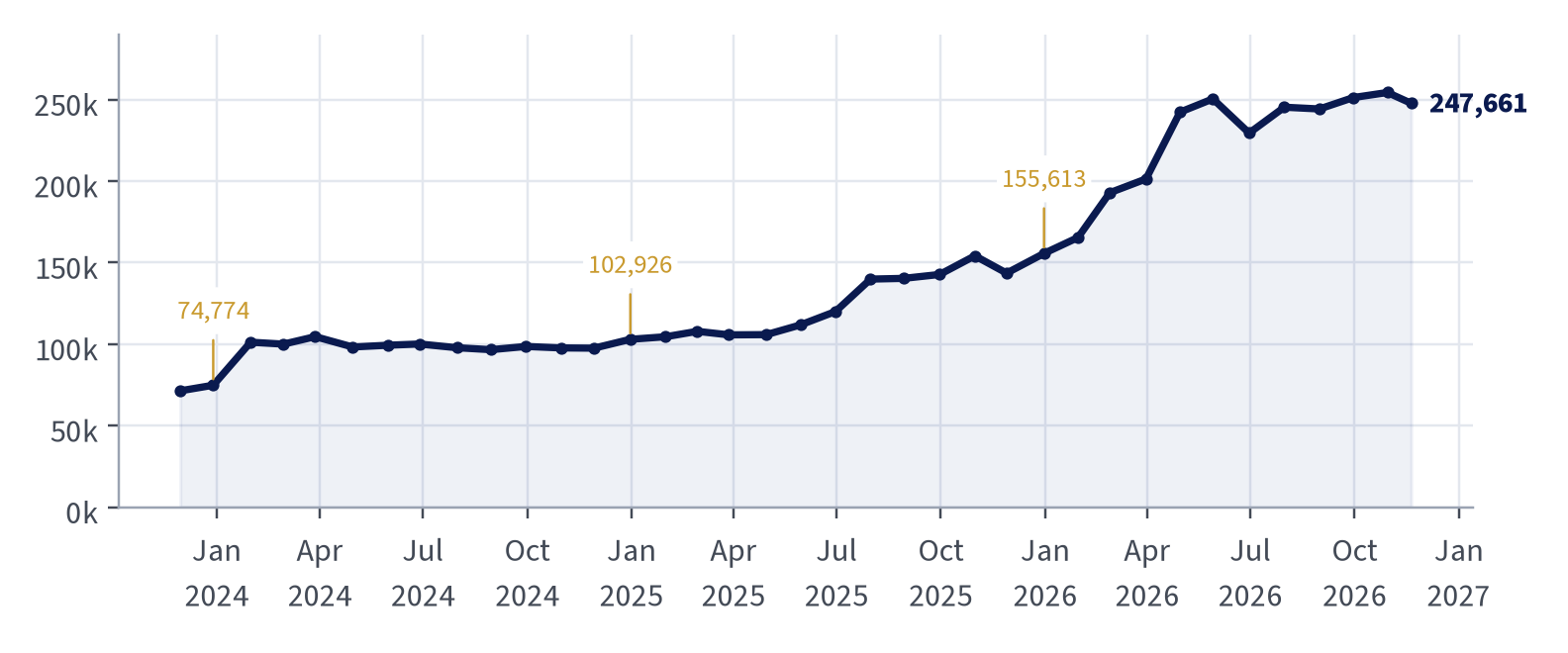
Shares (equities). Part-ownership of a company. Returns come from dividends and from changes in the share price. Shares can rise far more than bonds over long periods but can also fall sharply. The NGX All-Share Index closed at 247,660.74 on 20 November 2026, and one market-data provider puts its gain since the start of the year at about 59%. Strong past returns do not predict future ones; the same index can fall just as quickly. Between the end of May and the end of June 2026, for example, it fell from 250,385 to 229,419, an 8.4% drop in a month.
The NGX All-Share Index
Month-end closing values, November 2023 to 20 November 2026
Collective investment schemes (mutual funds). A fund manager pools money from many investors and buys a spread of assets. Money market, bond, equity, balanced and dollar funds are common. They are regulated by the SEC and make diversification affordable for small investors.
Real estate. Land and buildings can protect against inflation and produce rent, but they are expensive to buy, slow to sell and require careful legal checks on title.
Foreign-currency assets. Dollar deposits, Eurobonds and dollar funds protect against naira weakness. Between 16 and 20 November 2026 the naira’s official closing rate moved from ₦1,360 to ₦1,394 per dollar, a 2.5% loss for a naira holder in a single week. The same movement can also run the other way.
3. Risk has more than one face
- Inflation risk: your returns fail to keep up with prices.
- Market risk: asset prices fall because the whole market falls.
- Credit risk: a borrower (a company, a bank or a scheme) fails to pay you back.
- Interest-rate risk: bond prices fall when market rates rise.
- Currency risk: the naira value of foreign assets, or the dollar value of naira assets, changes.
- Liquidity risk: you cannot sell quickly without accepting a lower price.
- Fraud and governance risk: the people managing your money are dishonest or careless.
You cannot remove risk; you can only choose which risks to take, and how much. Higher promised returns always mean more risk somewhere, even if the salesperson does not mention it.
4. Diversification: what the professionals do
Diversification means spreading money across assets that do not all move together. Nigeria’s pension funds, which hold ₦31.80 trillion on behalf of more than 11 million savers, offer a useful illustration of how large, cautious investors spread their money: Federal Government securities made up about 56% of the total in August 2026, domestic shares about 20% and money market instruments about 10%.
Where Nigeria's pension money is invested
Pension fund assets by class, end-August 2026 (₦ trillion; total ₦31.80 trillion)
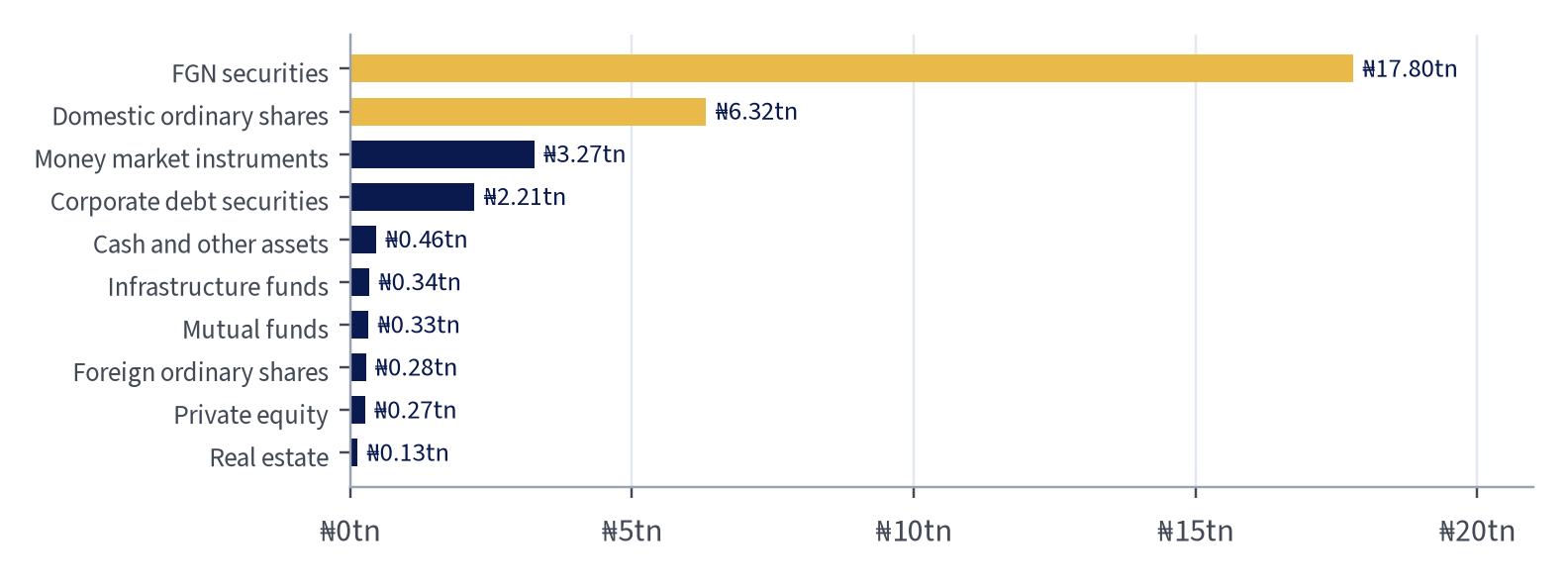
You are not a pension fund, and your mix should reflect your own goals, timeline and tolerance for loss. But the principle holds: no single asset carries the whole plan.
5. Time, compounding and the rule of 72
Compounding means earning returns on your returns. The rule of 72 gives a rough guide: divide 72 by the annual return to find how many years it takes money to double. At a nominal 18.9%, naira money doubles in about four years. At a real 4.2%, purchasing power doubles in about 17 years. The second number is the honest one, and it shows why starting early matters more than finding the perfect product.
6. Match the investment to the goal
| Goal | Time horizon | Suitable building blocks |
|---|---|---|
| Emergency fund | Immediate | Savings account, money market fund |
| Rent, school fees, a car | 1–3 years | Treasury bills, FGN Savings Bonds, bond funds |
| Children’s education | 5–15 years | Balanced or equity funds, shares, bonds |
| Retirement | 15+ years | RSA, voluntary pension contributions, diversified shares and bonds |
7. Protect yourself: the law is on your side
The Investments and Securities Act 2025 makes the SEC the apex regulator of the capital market, requires capital market operators and collective investment schemes to be registered, and brings virtual and digital assets within the definition of securities, so crypto platforms dealing with Nigerians must also be registered with the SEC. Ponzi and pyramid schemes are expressly prohibited, with a minimum fine of ₦20 million and up to ten years’ imprisonment for promoters.
Registration does not guarantee profit, but an unregistered operator gives you no protection at all.
Key takeaways
- Compare investments on the real return, after fees and inflation.
- A Treasury bill stop rate is a discount rate; the true yield is higher.
- Every asset trades return against risk and liquidity. Know which risks you are taking.
- Diversify across asset classes and, where sensible, currencies.
- Time is the investor’s best ally; start early and stay consistent.
- Check SEC registration before investing, including in digital assets.
Before-you-invest checklist
- What is my goal, and when will I need the money?
- Is this money I can leave untouched for that whole period?
- What is the expected real return after fees, VAT on fees and tax?
- What exactly is the asset, and who holds it on my behalf?
- Is the operator registered with the SEC (or CBN, PenCom, NAICOM)?
- How and how quickly can I get my money out?
- What could go wrong, and could I live with that loss?
- Does this add diversification, or concentrate my risk further?
Glossary
Asset class: a group of investments with similar features, such as shares or bonds.
Collective investment scheme: a pooled fund managed by a registered fund manager.
Discount rate: the rate used to price a bill below its face value.
Diversification: spreading money across assets that behave differently.
Liquidity: how quickly an asset can be turned into cash at a fair price.
Nominal return: the return before allowing for inflation.
Yield: the income an investment produces, as a percentage of its price.
Read the companies, not just the index
Astudity Spotlight publishes plain-English analyses of listed companies’ results, including recent work on Nigerian banks, MTN Nigeria and Dangote Cement, to help readers practise reading accounts. Treat them as learning material, not recommendations.
This publication is educational and is not personalised financial advice or a recommendation to buy or sell any security. Past performance is not a guide to future returns. Figures are dated and change often. Speak to a licensed adviser about your own circumstances.
More from Astudity Insights
No. 01 · Finance
How Money Moves in Nigeria
The Central Bank, the banks and the markets, explained
A plain guide to the institutions that set the price of money in Nigeria, the figures that matter as at November 2026, and how to read them for yourself.
No. 02 · Money
Making Every Naira Count
Personal finance when prices keep rising
How to budget, save, protect and grow household money in Nigeria, with naira examples, today's official rates and the rules that protect you.
No. 04 · Business Education
Running the Numbers
Business fundamentals for Nigerian founders and SME owners
The financial statements, cash habits, compliance duties and funding choices that separate businesses that last from businesses that merely survive.
No. 05 · Investor Relations
Earning the Market's Trust
Investor relations for growing companies, from first investor to the Exchange
What investor relations is, how the work changes as a company grows, the Nigerian rules that already apply, and a practical playbook for boards and founders.