Astudity Insights · No. 02 · Money
Making Every Naira Count
Personal finance when prices keep rising
How to budget, save, protect and grow household money in Nigeria, with naira examples, today's official rates and the rules that protect you.
Personal finance is not about being rich. It is about making deliberate choices with whatever money you have, so that it covers today’s needs, survives tomorrow’s surprises and still has something left for the future. In Nigeria that job is harder than in many places, because prices have risen quickly for several years and the naira has moved sharply against the dollar. It is also more important.
This guide sets out a simple order of priorities, uses current official figures, and points you to the institutions and laws that protect your money.
The numbers that shape your money, as at November 2026
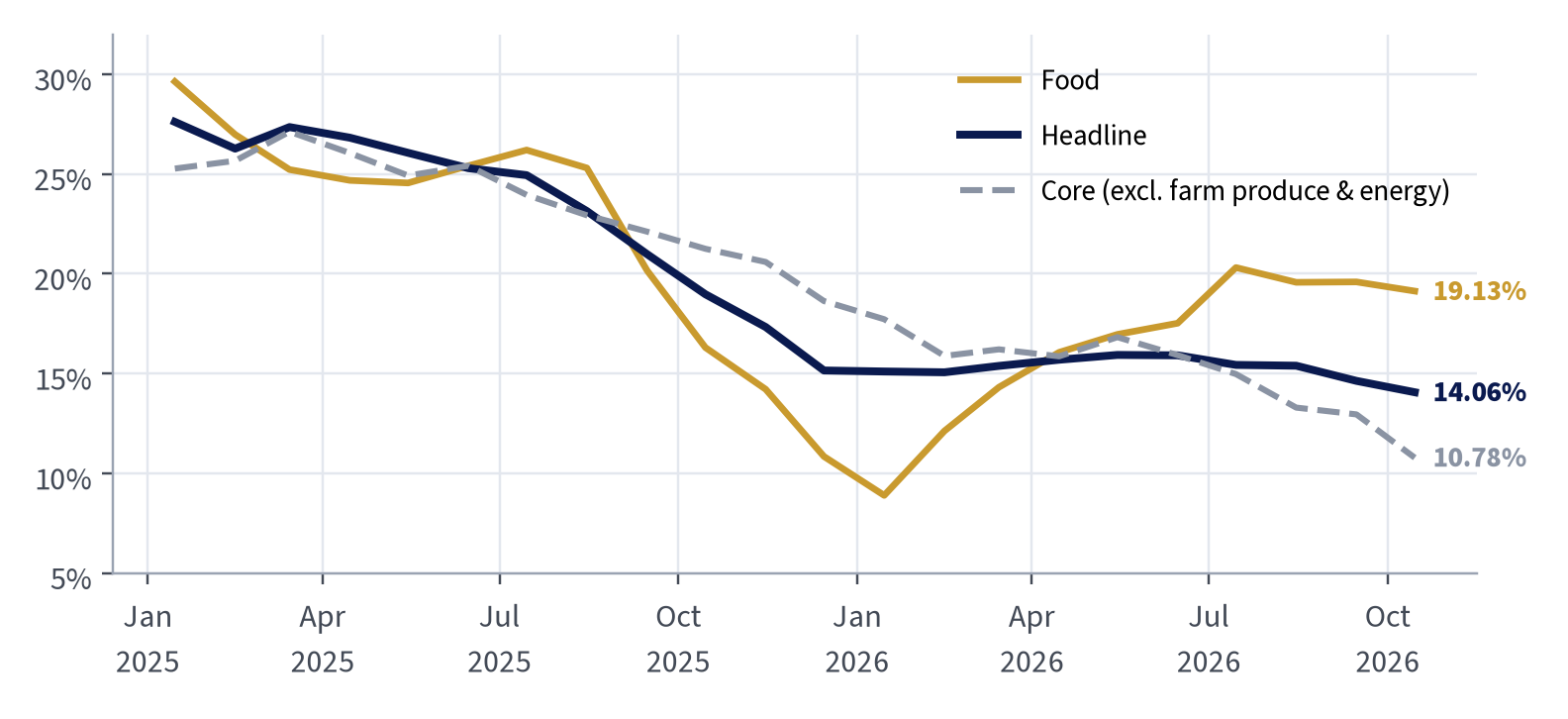
- Headline inflation: 14.06% (October 2026); food inflation: 19.13%
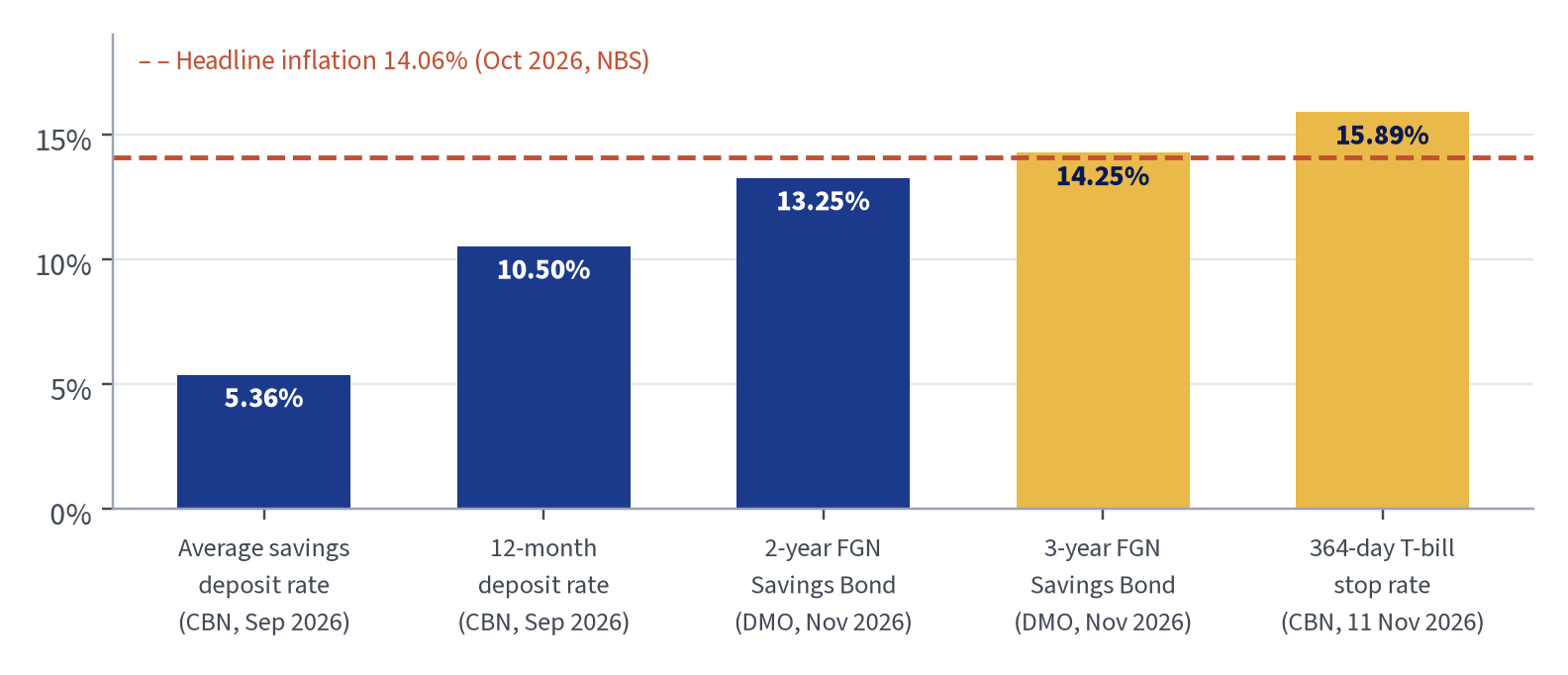
- One-year Treasury bill stop rate: 15.89% (11 November 2026 auction)
- FGN Savings Bond (November 2026 offer): 13.25% for two years, 14.25% for three years, from ₦5,000
- Deposit insurance (NDIC): up to ₦5 million per depositor per deposit money bank
- Minimum pension contribution: 18% of monthly emoluments (10% employer, 8% employee)
- Personal income tax: the first ₦800,000 of chargeable income is taxed at 0% from 1 January 2026
1. Understand what inflation does to idle money
Inflation is a tax nobody votes for. If prices rise by 14.06% over a year, ₦500,000 kept in cash buys only what about ₦438,366 buys today (₦500,000 ÷ 1.1406). Nothing was stolen, but about ₦61,600 of purchasing power has gone.
That is why the first question about any savings product is not “what does it pay?” but “does it pay more than inflation, after fees and tax?” The gap is your real return. A positive real return means your money is growing in what it can buy. A negative one means it is shrinking, however large the balance looks.
Remember too that your personal inflation rate may differ from the national one. In October 2026 food inflation was 19.13%, well above the headline rate. A household that spends most of its income on food is facing something closer to that figure.
Food, headline and core inflation since the CPI rebasing
Year-on-year change, January 2025 to October 2026
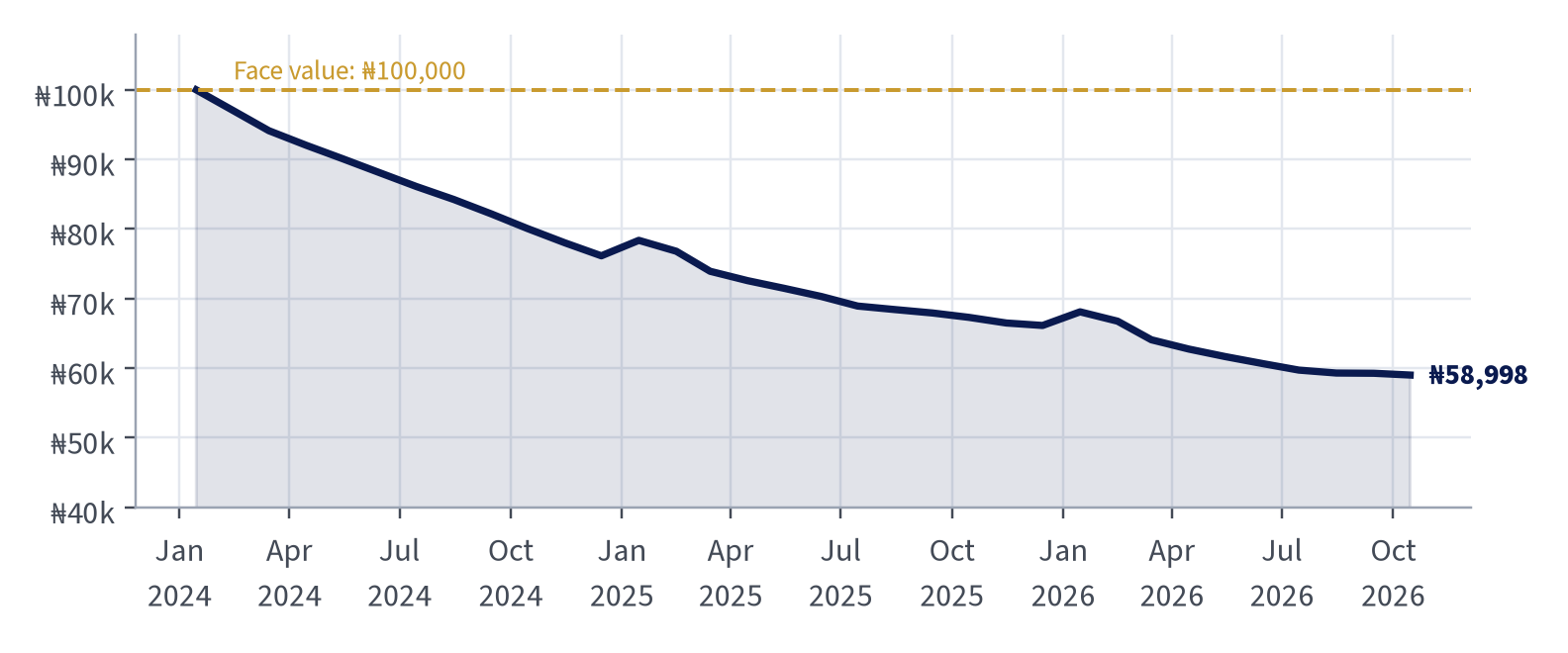
Over a longer stretch the effect is stark. Using the NBS price index, ₦100,000 kept as cash since January 2024 would by October 2026 buy only what about ₦59,000 bought at the start.
What ₦100,000 kept as cash since January 2024 can buy
Purchasing power of ₦100,000 at January 2024 prices, January 2024 to October 2026
2. Budget first: tell every naira where to go
A budget is simply a plan written before the month starts. A workable method for most households:
- Write down your take-home income for the month, after tax, pension and other deductions.
- List fixed costs: rent saved monthly, school fees saved monthly, transport, utilities, data, loan repayments.
- List variable costs: food, fuel, family support, personal spending.
- Pay yourself first: move a fixed amount to savings on payday, before you spend.
- Review at month-end and adjust the next month’s plan.
Worked example: a ₦450,000 monthly take-home pay
| Item | Monthly (₦) | Note |
|---|---|---|
| Rent set-aside (₦1.8m a year ÷ 12) | 150,000 | Saved monthly, not found in March |
| Food and household | 110,000 | Track this; it moves fastest |
| Transport and fuel | 55,000 | |
| Utilities, data, phone | 30,000 | |
| Family support | 25,000 | Budget it honestly |
| Emergency fund | 40,000 | Until the target is reached |
| Long-term saving and investment | 25,000 | Raise it as income grows |
| Personal and miscellaneous | 15,000 | |
| Total | 450,000 | Every naira has a job |
Illustrative figures only.
Annual costs such as rent and school fees cause most household cash crises in Nigeria, because they arrive as one large bill. Dividing them by twelve and saving monthly turns a crisis into a routine.
3. Build an emergency fund
An emergency fund is money set aside for job loss, illness, urgent repairs or a family emergency. A common rule of thumb is three to six months of essential expenses. Keep it somewhere safe and easy to reach quickly: a separate savings account or a money market fund, not shares or long-term bonds that may be worth less on the day you need them.
Safety first. The NDIC insures deposits at deposit money banks up to ₦5 million per depositor per bank. If your savings exceed that, consider spreading them across licensed banks. Check that any bank, microfinance bank or fintech is licensed by the CBN before you deposit.
4. Deal with expensive debt
Borrowing is not wrong, but high-interest consumer debt, including some digital loans, can cost more than any investment is likely to earn. Two simple rules:
- Borrow for things that pay you back (tools for your trade, education with a clear return), not for things that lose value.
- Clear the most expensive debt first while making minimum payments on the rest.
Before borrowing from any app, check that the lender is registered and approved by the relevant regulator, read the total cost (interest plus fees) and never grant access to your contacts or photos.
5. Save and invest in steps
Once you have a budget, an emergency fund and no expensive debt, you can save for goals. Match the product to the time you can leave the money untouched.
Under one year: Treasury bills and money market funds. Treasury bills are short-term government debt sold at a discount. At the 11 November 2026 auction the stop rates were 15.40% for 91 days, 15.79% for 182 days and 15.89% for 364 days. Because the stop rate is a discount rate, the return on the money actually paid is higher: on one public worked example, ₦100,000 paid for a 364-day bill at 15.89% would return about ₦118,830 at maturity before fees, roughly 18.9%. Individuals usually buy through a bank, stockbroker or app; minimums and fees vary by provider.
Two to three years: FGN Savings Bonds. The DMO offers these monthly to retail savers. In November 2026 the two-year bond paid 13.25% and the three-year bond 14.25% a year, with interest paid quarterly. You can start from ₦5,000 and buy in multiples of ₦1,000, up to ₦50 million, through DMO-appointed stockbrokers. Compare those rates with inflation: the three-year rate was only just above October’s 14.06%, while the average savings deposit rate reported by the CBN for September 2026 was 5.36%.
Savings and government rates against inflation
Latest published rates, per cent a year, before fees and tax
Long term: pensions, shares and diversified funds. Money you will not need for five years or more can take more risk in search of higher returns. Our companion publication, Investment, covers this in detail.
6. Make the most of your pension
The Pension Reform Act 2014 sets a minimum contribution of 18% of monthly emoluments, of which the employer pays at least 10% and the employee 8%. The money sits in your Retirement Savings Account (RSA), managed by a Pension Fund Administrator (PFA) of your choice and regulated by the National Pension Commission (PenCom).
The system is large and growing. Pension fund assets reached ₦31.80 trillion at the end of August 2026, with 11,391,008 RSA holders. Four practical points:
- Check your statement. Confirm that your employer’s contributions arrive every month.
- Make voluntary contributions if you can; they raise your retirement income.
- Use your RSA for a home, if it fits your plan. PenCom’s guidelines allow an RSA holder with at least 60 months of mandatory contributions to use up to 25% of the RSA balance once, as equity contribution for a residential mortgage.
- Self-employed? You can join the scheme too; ask a PFA about the micro pension plan.
7. Know your tax position
The Nigeria Tax Act 2025 changed personal income tax from 1 January 2026. The first ₦800,000 of chargeable income is taxed at 0%, and rates then rise in bands from 15% to 25%. Many lower-paid workers now pay less, or nothing; higher earners should check how the bands apply to them. Keep payslips, pension statements and receipts for allowable reliefs, and ask your employer or a tax adviser if your deductions look wrong.
8. Protect yourself from scams
If an “investment” promises high, fixed returns with little or no risk, pays old members with new members’ money or rewards you mainly for recruiting others, it is very likely a Ponzi scheme. The Investments and Securities Act 2025 expressly prohibits such schemes; on conviction a promoter faces a fine of not less than ₦20 million, up to ten years’ imprisonment, or both.
Before you hand over money, ask three questions: Is the firm registered with the SEC (or the CBN, PenCom or NAICOM, as the case may be)? Can I see what the money is actually invested in? Can I get my money back, and how quickly?
Key takeaways
- Judge every savings product by its real return: the rate after fees, tax and inflation.
- Save annual bills (rent, school fees) monthly, and pay yourself first on payday.
- Keep three to six months of essential costs in a safe, accessible place.
- Clear expensive debt before investing.
- Use your pension well: check contributions, add voluntary ones, know the 25% mortgage option.
- Registration first, returns second. The ISA 2025 criminalises Ponzi schemes.
Your 30-day action checklist
- Write this month’s budget before the month starts.
- Open a separate account for your emergency fund and set up a payday transfer.
- Divide your rent and school fees by twelve and save that sum monthly.
- Download your latest RSA statement and check every month’s contribution.
- List your debts by cost and target the most expensive first.
- Check the current Treasury bill and FGN Savings Bond rates on the CBN and DMO sites.
- Check the SEC register before responding to any investment offer.
Glossary
Emergency fund: cash set aside for unexpected costs, kept safe and accessible.
FGN Savings Bond: a retail Federal Government bond paying fixed interest quarterly.
PFA: Pension Fund Administrator, the licensed company that invests your RSA.
Real return: what an investment earns after inflation.
RSA: Retirement Savings Account, your personal pension account.
Treasury bill: short-term government debt sold below face value and repaid at face value.
Keep learning
Astudity Spotlight, published by Astudity Limited, reports monthly on inflation, the naira, interest rates and the markets in plain English, and its mailing list is free. Astudity Books also publishes titles on personal growth and wisdom for everyday life.
This publication is educational and is not personalised financial advice. Rates and figures are dated and change often. Consider your own circumstances and speak to a licensed adviser before making financial decisions.
More from Astudity Insights
No. 01 · Finance
How Money Moves in Nigeria
The Central Bank, the banks and the markets, explained
A plain guide to the institutions that set the price of money in Nigeria, the figures that matter as at November 2026, and how to read them for yourself.
No. 03 · Investment
Risk, Return and the Real Rate
An investor's primer for Nigeria
What investing really means, how to compare Treasury bills, bonds, shares and funds on equal terms, and how to protect yourself while you build long-term wealth.
No. 04 · Business Education
Running the Numbers
Business fundamentals for Nigerian founders and SME owners
The financial statements, cash habits, compliance duties and funding choices that separate businesses that last from businesses that merely survive.
No. 05 · Investor Relations
Earning the Market's Trust
Investor relations for growing companies, from first investor to the Exchange
What investor relations is, how the work changes as a company grows, the Nigerian rules that already apply, and a practical playbook for boards and founders.